How the Metaverse will change our working world

How the Metaverse will change our working world

The Metaverse is not about putting on VR glasses. It will touch very many areas of our daily lives and create new spaces.

Putting on a pair of data glasses and then moving quite naturally with an avatar between countless worlds in a three-dimensional Internet in the same way that we switch back and forth between websites today certainly seems outlandish or difficult to imagine for many people at the moment. But experts are convinced that in ten years it will be part of our everyday lives. A large part of our lives, both private and professional, will then take place in the metaverse. There is no doubt that this will be a technological gamechanger of the future.

One of many questions is, for example, what would customers buy in the Metaverse? What are their motives? Are their needs different from those in the real world?

From my point of view, the following 5 points reflect in which areas the metaverse will change our lives the most in the near future:

  1. The Metaverse is a virtual reality that offers many possibilities for the future of work. We can live, work and play in a three-dimensional world. We can customize our avatars, create interactive presentations, design virtual spaces and collaborate on projects.
  2. The metaverse requires new skills and qualifications. We need to learn how to navigate the virtual world, how to communicate and collaborate with others, how to be creative and innovative . We must also consider ethical and legal issues that arise from the Metaverse.
  3. The Metaverse enables new forms of collaboration and learning. We can meet with colleagues, customers and partners from around the world in an immersive environment. We can learn from experts who share their knowledge in virtual courses. We can also gain practical skills by running simulations and scenarios that prepare us for real-world situations.
  4. The metaverse creates new business models and markets. We can offer digital products and services that the real world does not. We can also create and trade digital assets based on blockchain technologies . We can also reach new groups of customers who are active in the Metaverse.
  5. The Metaverse is changing our work culture and our well-being. We can work more flexibly and autonomously by determining our own working hours and locations. We can also have more fun and variety by combining our work with play and leisure elements . But we also need to take care of our mental and physical health by finding a balance between the virtual and the real world .

So the Metaverse is more than just a game or an escape from reality. It is a platform for innovation, creativity and collaboration. It will change the way we work in the coming years and open up new possibilities. Are you ready for the Metaverse?

Metaworking reduces greenhouse gases

Metaworking reduces greenhouse gases

The metaverse can make an important contribution to reducing global warming.

This is confirmed by a Cornell University study.

👉 In the USA alone, the targeted use of metaverse technologies could reduce greenhouse gas emissions by more than 10 gigatons by 2050

As much as we are happy that personal meetings, events and business trips are possible again after the pandemic, we should also have learned that many things are dispensable and that the metaverse has good alternatives in store. A good mix of both worlds already helps here.

Collaboration in the metaverse as a hybrid approach is just one example here. Such meetings are more spontaneous than physical meetings and still create a "virtual" proximity.

New Work In the metaverse

New Work In the metaverse

In stores from June 8

The release date is set!

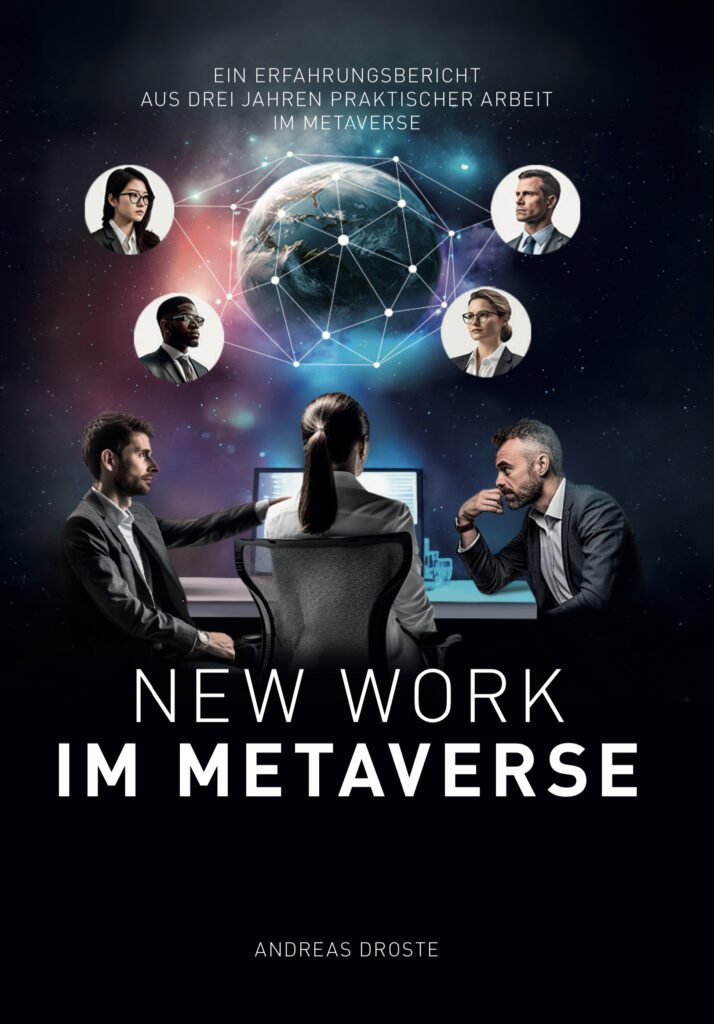
Based on concrete use cases, the relevance of the metaverse as a technological driver for New Work is presented. It is intended as an inspiration to take the first practical steps in the metaverse today. The technology is there. What is needed now are creative ideas and the courage to start something new.


The book will be available for order at all major booksellers starting Thursday.
It will be available as a softcover and eBook:

ISBN Softcover: 978-3-347-81797-5

ISBN e-book: 978-3-347-81806-4

Further information and multimedia background information is available here:

Https://newworkmeta.drostenet.de

PWC study sees cloud gaming on the rise

Cloud gaming is picking up speed, at least PWC claims in a recent study.


Since the future of the Metaverse is in the cloud, and the technical framework is almost identical to that of gaming, I think this statement is very exciting.
The issue of latency is mission-critical for both.
Unfortunately, PWC comes to the wrong conclusion:
Here, the bandwidth in the network is presented as a limiting factor.

❗️Latenz has nothing to do with bandwidth tun❗️

The decisive factor is the network architecture. What is needed is a high-performance edge infrastructure in the networks.

An example: The rendering of elaborate Spaces must not take place in a cloud data center 6000 kilometers away, but in physical proximity to the user.

Such infrastructure will be a key locational advantage in the Metaverse in the future.

Less bandwidth and better graphics through texture baking

When we talk about cloud-based metaverse applications like T-Systems' Magenta Metaverse, interactivity and immersion are key!

Bandwidth and GPU-powered cloud data centers are technical basics.
But almost more important are the architecture and design of the spaces. Here we can learn a lot from the gaming industry.

👉 One of the most common techniques is the so-called "texture baking".

In simple terms, this means that you transfer the high-resolution textures of a static 3D model to a game-ready model with fewer polygons.
The result is a high-quality but interactive object with less computational and bandwidth overhead.

As a first demonstrator, we tried this out with amazing results at our #virtualinnovationcenter! (Above without and below with texture baking) 🚀

It is very important to optimize industry cases to ensure maximum customer experience without specific client hardware.

Empathy in the metaverse through haptic feedback

Empathy in the metaverse is a very important topic when we focus on social interaction and mental health.

There are typically 5 senses that allow us to receive empathy:

  1. Acoustic stimuli
  2. Visual stimuli
  3. Smell stimuli
  4. Taste stimuli
  5. Haptic stimuli

1 and 2 can be transferred to the metaverse without any problems.

👉 Now, California-based startup emerge.io is launching a tabletop device that envelops virtual objects and interactions with ultrasonic waves in the air.

Technologies like these will provide groundbreaking support for "haptic stimuli" and open up a broad field of new empathy-driven applications in the metaverse.

#NewWork #MentalHealth #Empathy #DigitalHealth #Metainnovator